By Lance Cpl. Roger L. Nelson |
Beach, Fla. native.

Sgt, Andrew Jones (left), instructor, Scout Sniper Basic Course, assists a student during the stalking portion of the 10-week long training at Schofield Barracks, Oct. 13.
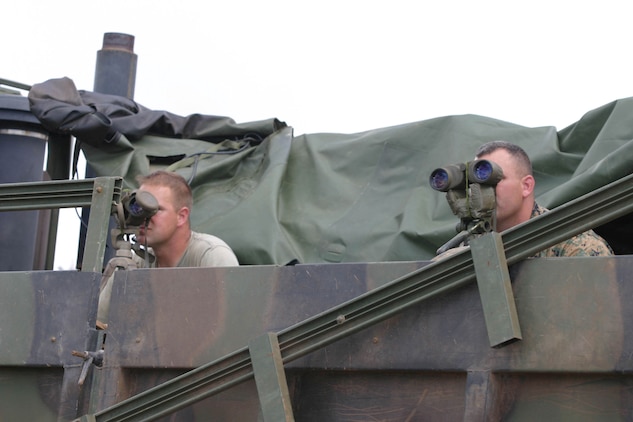
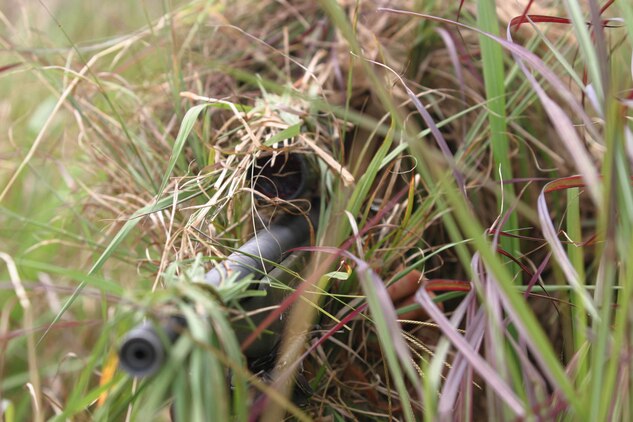
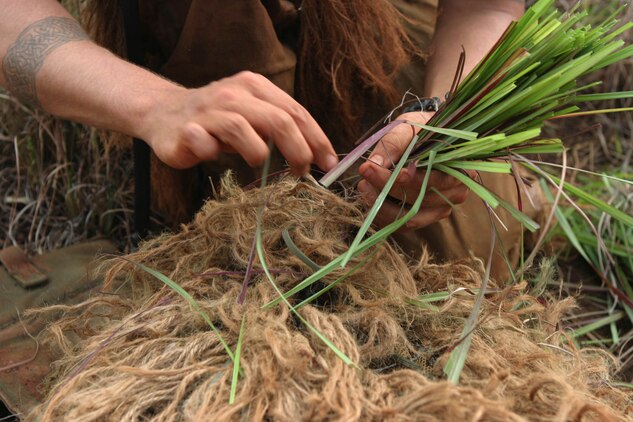
Lance Cpl. Geoff A. Kercher ties pieces of grass to his Ghillie suit in an attempt to camouflage himself during the stalking portion of the Scout Sniper Basic Course at Schofield Barracks’ East Range Training Area, Oct. 13. Students attach what they can to their Ghillie suit in order to blend in with their surroundings as they stalk their target, hopefully, unnoticed.
“After the Marines make their first shot, they must call for an identification check to make sure the student can actually see the observers. The observers hold up a letter and the Marine must identify the letter to prove that he can see the truck.”During this process, if the observer thinks he sees the sniper, he will radio to a walker and will direct him to where he thinks the sniper is.“The observers only get three chances to find the sniper, if he isn’t spotted then he gets to take his shot,” said Jones, a Kirkland, Wash. native. “Anything like a shine from the scope or something that doesn’t look natural or stands out can give away a snipers position.” Jones explained that a lot of the students have a problem with overhead movement.“They just don’t understand that they’re movement shakes everything above and around
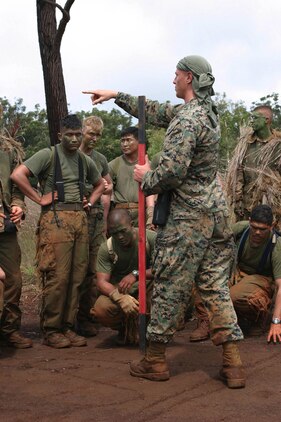
Sgt. Michael A. McClay, chief instructor, Scout Sniper Basic Course, gives the students a few words of advice before releasing them to start their 700-meter stalk Oct. 13, at Schofield Barracks’ East Range Training Area.
them,” said Jones. “Also the students find it hard to find the observers. Low crawling for so long and then looking up and trying to see the observers can be hard, because you may lose your sense of direction. So a lot of students have problems with this.”Jones said, the students are used to being told how to move and are unsure of their own abilities.“During School of Infantry or Marine Combat training the Marines are being told the whole time which way to go,” said Jones. “Now they’re having to start to think on their own, and to depend on themselves.”Out of the 28 students that started the course, 24 remain in the training. These Marines will continue on with the next portion of the course.“Everything the Marines have learned and are going to learn is all going to help them very much in their final exercise,” said Jones. “They need to pay attention to everything because it’s all going to be used in the end.”
I want to personally thank Marines News for the above article. Please click the link below for more information
Click Marines
 Gunner's Mate & EDM's Military Gear